

Event Marketing Strategy: What It Is and How to Build One
You plan an event. You spend months organizing every detail. But when the day arrives, only a fraction of your target audience shows up. Worse, the buzz you hoped would follow never materializes. Empty seats and silent social feeds are symptoms of the same problem: you promoted an event without a cohesive strategy behind it.
An event marketing strategy solves this. It's your documented plan for attracting the right people, creating memorable experiences, and turning attendees into advocates who amplify your message. When done right, it transforms scattered promotional efforts into a coordinated campaign that fills venues and generates authentic content people actually want to share.
This guide breaks down exactly what an event marketing strategy is and walks you through building one from scratch. You'll learn how to set measurable goals, target the right audience segments, create content that spreads organically, choose promotional channels that match your budget, and measure what actually matters. By the end, you'll have a clear framework to make your next event your most successful one yet.
What is an event marketing strategy
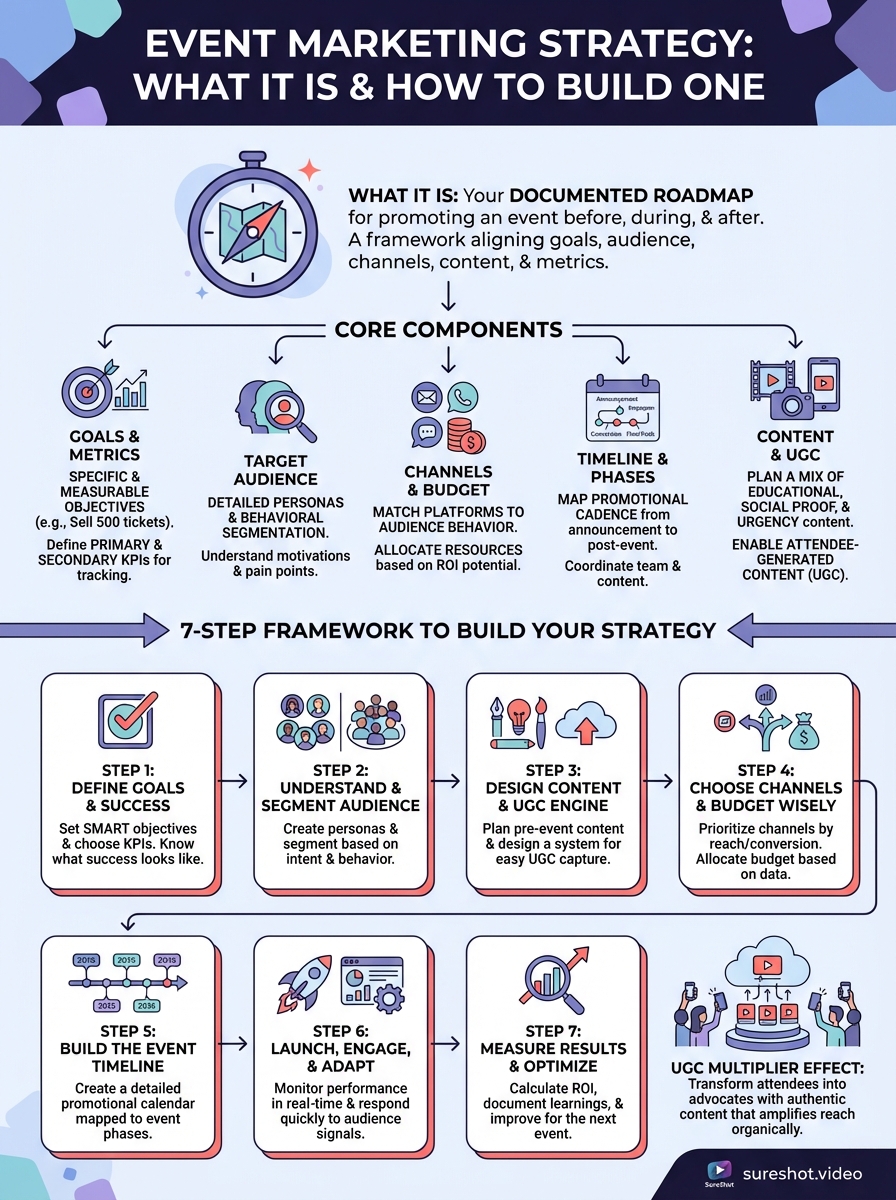
An event marketing strategy is your documented roadmap for promoting an event to your target audience before, during, and after it happens. You define specific goals, identify who you want to reach, choose promotional channels, create content, set timelines, and establish metrics to measure success. This framework guides every promotional decision you make and ensures your team works toward the same objectives.
The difference between having a strategy and winging it shows up in your results. When you answer "what is event marketing strategy" for your specific event, you create a single source of truth that aligns your promotional efforts across email, social media, partnerships, paid advertising, and content creation. Your strategy documents what you'll say, where you'll say it, when you'll say it, and how you'll know if it worked.
A strategy without documentation is just a collection of random tactics hoping to succeed.
Core components you need to include
Your event marketing strategy must contain these five essential elements to function effectively. First, you set clear goals with specific numbers attached (sell 500 tickets, generate 50 qualified leads). Second, you define your target audience segments and understand what motivates each group. Third, you map out all promotional channels you'll use and allocate budget to each. Fourth, you create a timeline showing what happens at every stage from announcement to follow-up. Fifth, you establish metrics and tracking methods to measure performance.
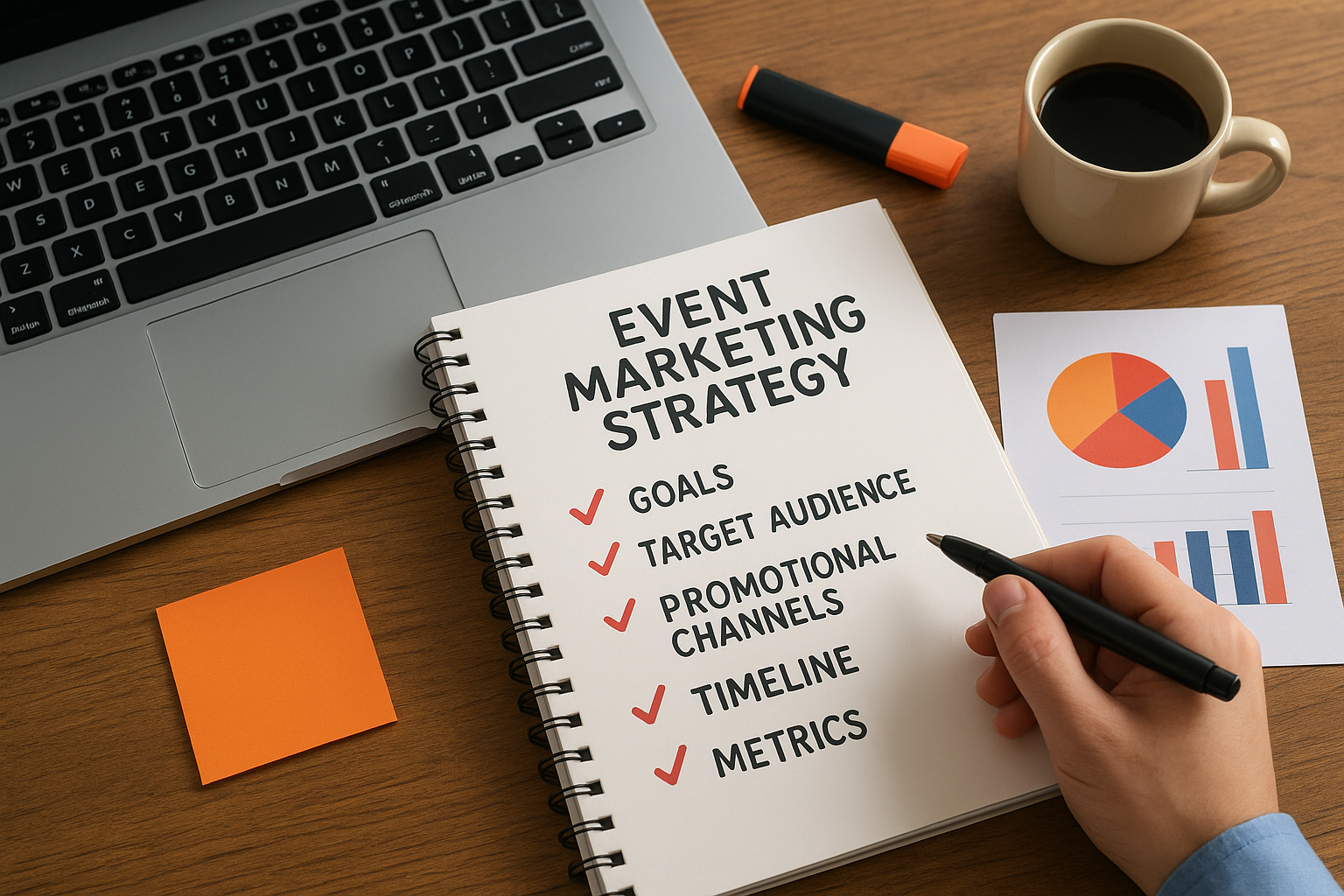
Each component connects to the others. Your goals inform which audience segments matter most. Your audience determines which channels you prioritize. Your channels shape your timeline. Your timeline affects your budget allocation. When one piece changes, you adjust the others accordingly.
Strategy versus individual tactics
Many event organizers confuse tactics with strategy. Posting on social media is a tactic. Running Facebook ads is a tactic. Sending email invitations is a tactic. Your strategy tells you which tactics to use, when to deploy them, and how they work together to achieve your goals. It's the master plan that makes individual tactics effective rather than random.
Think of your strategy as the architectural blueprint for a building. Tactics are the individual materials and construction methods. You need both, but the blueprint comes first. Without it, you might use quality materials but still end up with a structure that doesn't meet your needs.
Step 1. Define goals and event success
You cannot market an event effectively if you don't know what success looks like. Before you write a single social post or send any invitations, you need to define specific, measurable goals that tell you whether your event achieved its purpose. These goals shape every decision you make about targeting, messaging, channels, and budget allocation.
Understanding what is event marketing strategy starts here because your goals determine everything else. An event designed to generate qualified sales leads requires a completely different promotional approach than one meant to build community engagement or launch a new product. Your goals also help you decide which metrics matter and which ones you can ignore.
Set SMART objectives for your event
Your event goals must be SMART: Specific, Measurable, Achievable, Relevant, and Time-bound. Instead of "increase brand awareness," you write "generate 10,000 social media impressions from event hashtag content within 48 hours of the event." Instead of "get more attendees," you specify "sell 300 tickets by March 15th with an average ticket price of $75."
Vague goals produce vague results. Specific goals produce specific actions.
Write down three to five objectives that cover both attendance and outcomes. Your first goal typically addresses how many people you want to attend. Your remaining goals focus on what you want those attendees to do: sign up for your newsletter, make a purchase, share content, book a demo call, or join your community. Each goal needs a number and a deadline attached to it.
Here are concrete examples of strong event goals:
- Sell 500 tickets generating $37,500 in revenue by February 28th
- Collect 200 email addresses from attendees who opt in to your newsletter
- Generate 50 qualified leads with contact information and follow-up permission
- Achieve 15,000 social media reach through attendee-generated video content
- Secure 5 sponsor commitments worth $10,000 total by January 15th
Choose primary and secondary KPIs
Your goals tell you where you want to go. Your key performance indicators (KPIs) tell you how you're progressing toward those goals in real time. You need to select which metrics you'll track before, during, and after your event. These become your dashboard for making decisions and course corrections.
Separate your KPIs into primary and secondary categories. Primary KPIs directly measure goal achievement (ticket sales, lead generation, revenue). Secondary KPIs indicate whether you're on track (website traffic, email open rates, social engagement, early registrations). When secondary KPIs drop, you know to adjust your tactics before your primary KPIs suffer.
Track these specific metrics for promotional effectiveness:
| Metric Category | What to Measure | Why It Matters |
|---|---|---|
| Awareness | Website visits, social reach, email list growth | Shows how many people know about your event |
| Interest | Registration starts, email opens, content engagement | Indicates who's considering attending |
| Conversion | Completed registrations, tickets sold, revenue | Measures actual commitment |
| Advocacy | Social shares, user-generated content, referrals | Reveals organic promotion effectiveness |
Step 2. Understand and segment your audience
You cannot market to everyone effectively, so you need to identify who actually needs to attend your event and what motivates them to register. Generic messaging produces generic results. When you understand your audience segments deeply, you create targeted campaigns that speak directly to each group's specific needs, pain points, and desires. This precision makes every promotional dollar work harder.
Answering what is event marketing strategy requires knowing exactly who you're trying to reach. Your event might appeal to multiple distinct groups, each with different motivations and objections. A music festival attracts both die-hard fans of headlining artists and casual attendees looking for weekend entertainment. Your messaging to each group must differ because their reasons for attending differ completely.
Create detailed attendee personas
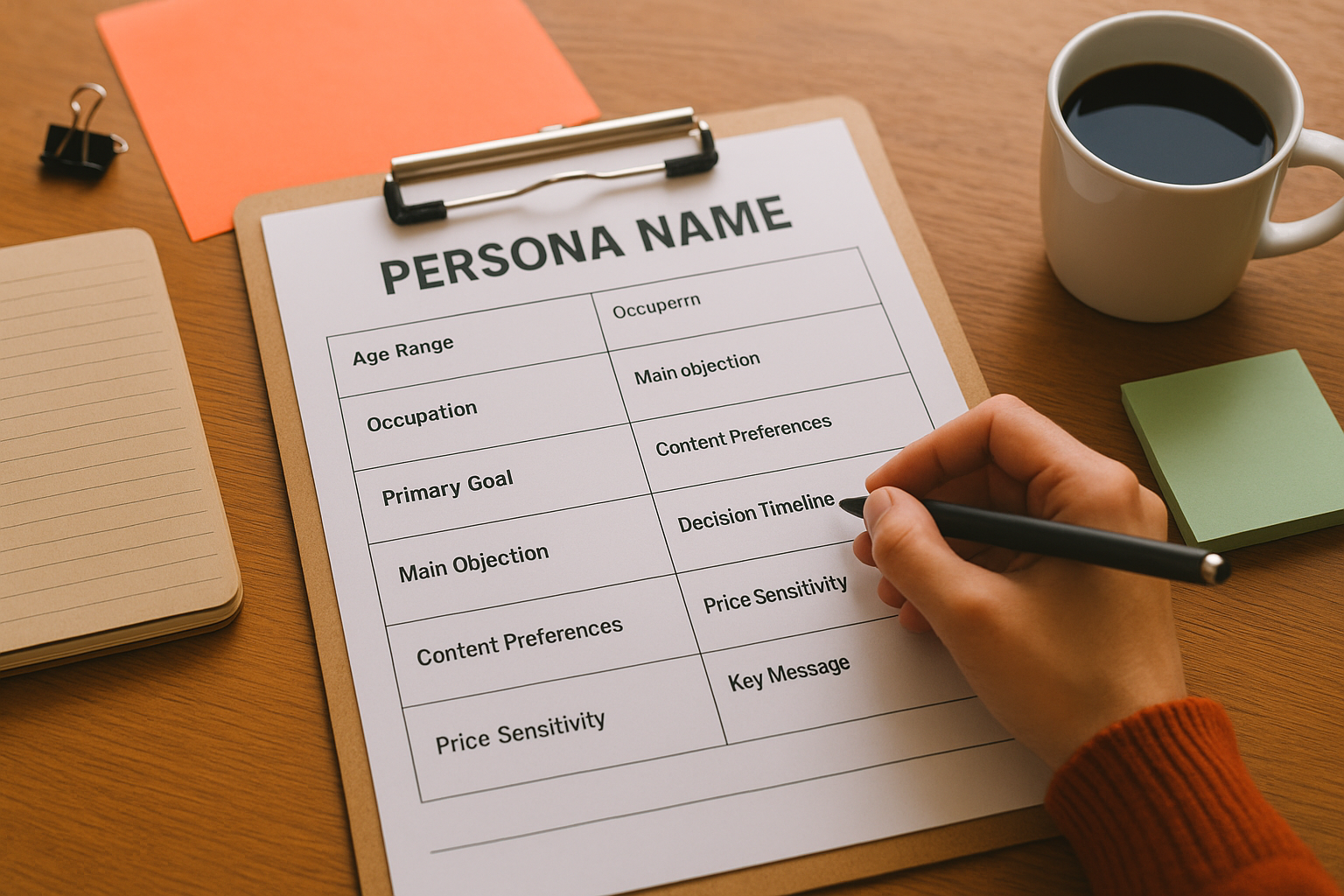
You build effective targeting by creating two to four detailed personas that represent your ideal attendees. Each persona needs a name, demographic details, goals, challenges, information sources, and decision-making factors. These aren't vague descriptions but concrete profiles that help you write specific messages and choose appropriate channels.
Start with data from previous events if you have it. Look at who actually attended, purchased tickets, or engaged with your content. Survey past attendees about their motivations. Interview people in your target groups. Combine this research into personas that your team can reference when making marketing decisions.
Personas transform abstract audiences into real people with specific needs you can address.
Here's a template for building actionable personas:
PERSONA NAME: [Give them a real name]
Age Range: [Specific range like 25-34]
Occupation: [Job title or industry]
Primary Goal: [What they want from your event]
Main Objection: [Why they might not attend]
Content Preferences: [How they consume information]
Decision Timeline: [How far ahead they plan]
Price Sensitivity: [Budget considerations]
Key Message: [What convinces them to register]
Segment based on behavior and intent
Beyond static personas, you need to segment your audience by behavior and where they sit in the decision journey. Someone who visited your event page three times shows higher intent than someone who saw one social post. You message these groups differently and with different urgency.
Create segments based on these behavioral indicators and adjust your targeting accordingly. Your early registrants receive different communications than people who opened three emails but haven't registered. Price-sensitive segments get discount code reminders. VIP segments hear about exclusive experiences. Behavioral segmentation lets you personalize at scale without writing thousands of individual messages.
Apply these practical segmentation categories:
| Segment Type | Characteristics | Marketing Approach |
|---|---|---|
| Hot Leads | Visited registration page, started signup | Urgency messages, limited-time offers |
| Warm Prospects | Engaged with content, opened emails | Benefits-focused content, social proof |
| Cold Audience | Minimal engagement, new contacts | Awareness content, event highlights |
| Past Attendees | Attended previous events | Loyalty messaging, early access |
| Referrals | Came through attendee shares | Community-focused messaging |
Step 3. Design your content and UGC engine
Your content drives awareness, builds excitement, and ultimately convinces people to register for your event. You need a strategic content plan that covers what you'll create, who will create it, when you'll publish it, and how you'll encourage attendees to generate content on your behalf. Most event marketers focus only on what they produce themselves, missing the massive opportunity in user-generated content (UGC) that multiplies reach organically and costs nothing to create.
When you understand what is event marketing strategy at this stage, you realize that modern event promotion isn't about broadcasting messages but about enabling your audience to tell your story. Authentic videos, photos, and testimonials from real attendees prove more persuasive than any promotional copy you write. Your job is designing systems that make content creation easy and attractive for attendees while maintaining quality standards.
Plan your pre-event content mix
You need a balanced content calendar that educates, entertains, and converts your target audience. Create content in three categories: educational (what attendees will learn or experience), social proof (testimonials, past highlights, speaker announcements), and urgency-driven (early bird deadlines, limited tickets, exclusive offers). Each piece should serve a specific purpose in moving prospects toward registration.
Map your content types to different stages of awareness. Early content introduces your event and builds general interest. Middle-stage content highlights specific benefits and addresses objections. Late-stage content creates urgency and removes final barriers to purchase. Vary your formats between video clips, photos, written posts, infographics, and live updates to match how different audience segments consume information.
Content that shows real moments from past events outperforms polished promotional materials by creating genuine connection and trust.
Schedule your content production around these essential formats:
| Content Type | Purpose | Production Timeline |
|---|---|---|
| Announcement video | Build initial awareness | 6-8 weeks before |
| Speaker/lineup reveals | Generate excitement, attract specific segments | 4-6 weeks before |
| Behind-the-scenes content | Create insider feeling, build community | Ongoing |
| Testimonial clips | Provide social proof, address objections | 2-4 weeks before |
| Countdown posts | Drive urgency | Final 2 weeks |
| Live event coverage | Engage remote audience, create FOMO | During event |
Design your attendee content capture system
Transform every attendee into a content creator by building a simple system for collecting their videos and photos. Give them clear instructions on what to capture, an easy submission method, and compelling reasons to participate. The best systems work through dedicated mobile apps or simple web forms where attendees upload content using unique event codes during and after your event.
Your UGC strategy needs three components: clear guidelines on what content you want (30-second highlight moments, specific experiences, genuine reactions), technical infrastructure for easy uploads (mobile-optimized, minimal steps, instant confirmation), and incentives that motivate participation (feature their content in promotions, run contests, offer exclusive perks). Make sharing easier than not sharing, and you'll collect hundreds of authentic videos that showcase your event through attendee perspectives.
Brief attendees with this simple UGC collection template:
Event: [Your Event Name]
Access Code: [Unique PIN]

What to Capture:
- Your favorite moment or performance
- One thing that surprised you
- A message to next year's attendees

How to Submit:
1. Open [app/website URL]
2. Enter code: [PIN]
3. Upload your video (30-90 seconds)
4. Grant permission to use

Why Share:
- Get featured on our social channels
- Enter to win [incentive]
- Help future attendees see what they're missing
Step 4. Choose channels and budget wisely
You face dozens of potential promotional channels for your event, but spreading your budget too thin across all of them guarantees mediocre results everywhere. Smart channel selection means identifying where your target audience actually spends time and concentrating resources on the platforms that deliver the highest return. Your budget should flow to channels that match your audience behavior, not channels you personally prefer or think you should use.
Understanding what is event marketing strategy at this phase means accepting that not every channel deserves equal investment. A B2B conference targeting executives might invest heavily in LinkedIn ads and email marketing while avoiding TikTok entirely. A music festival targeting college students makes the opposite choice. Your channel mix must reflect actual audience behavior, proven conversion rates from past campaigns, and the specific goals you defined in Step 1.
Match channels to audience behavior
You choose promotional channels by analyzing where your personas consume information and make purchase decisions. Start by listing every potential channel (email, social platforms, paid search, organic search, partnerships, influencer collaborations, PR, community forums). Then map each channel against your primary audience segments using actual data about their media consumption habits.
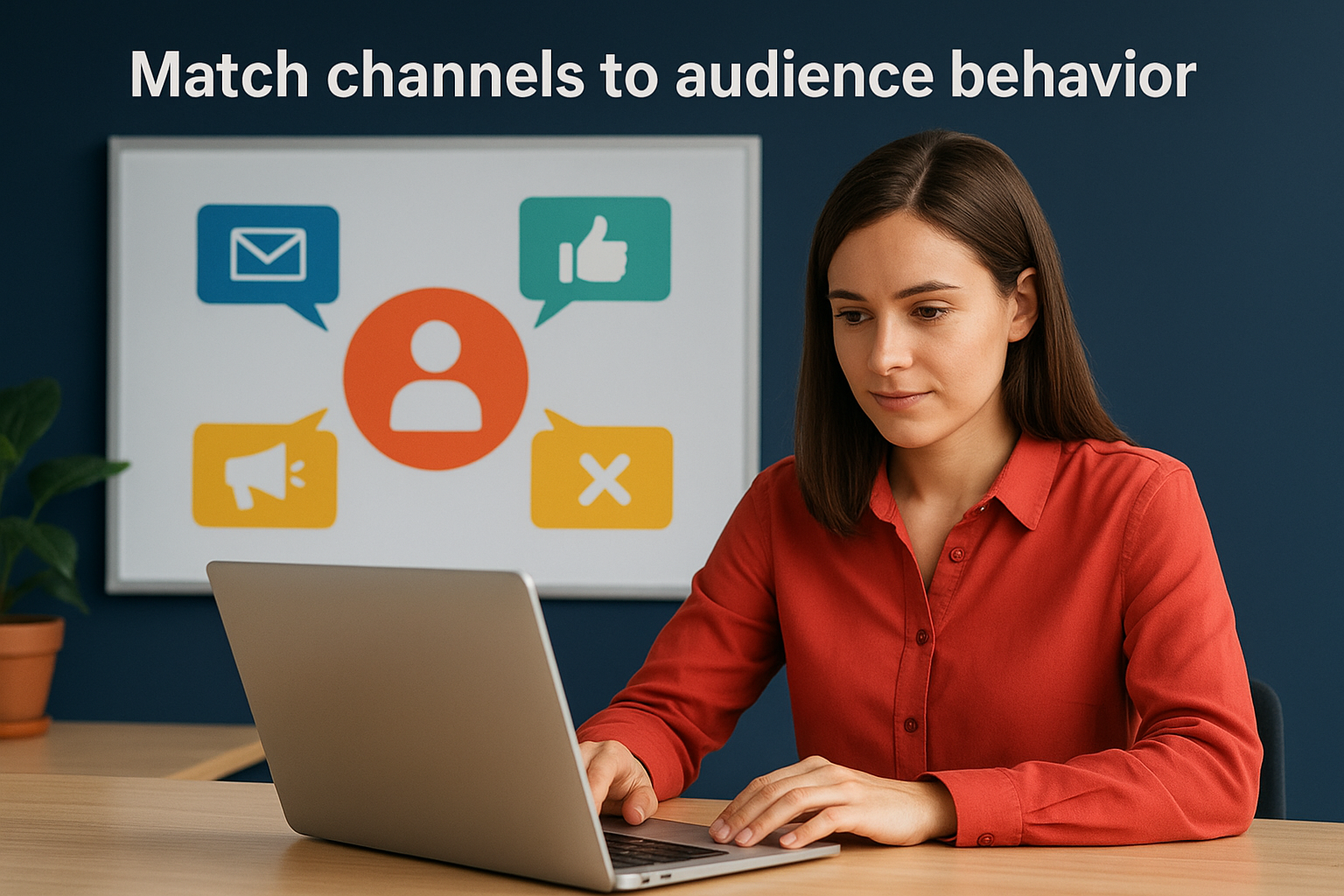
Prioritize channels based on three factors: reach potential (how many target attendees you can access), engagement rates (how actively your audience interacts with content there), and conversion capability (how easily prospects can register from that channel). Email typically delivers the highest conversion rates but limited reach beyond your existing list. Social media offers massive reach but lower direct conversion. Paid search captures high-intent prospects actively looking for events like yours.
Channels that facilitate easy sharing multiply your reach organically without increasing your budget.
Apply this channel selection framework:
| Channel Type | Best For | Budget Priority | Key Metric |
|---|---|---|---|
| Email marketing | Past attendees, existing contacts | High (15-25% of budget) | Click-to-register rate |
| Organic social | Building community, UGC amplification | Medium (10-15%) | Share rate, engagement |
| Paid social ads | Audience expansion, retargeting | High (25-35%) | Cost per registration |
| Event partnerships | Credibility, audience sharing | Low-Medium (5-15%) | Referred attendees |
| Influencer collaboration | Niche audiences, social proof | Medium (10-20%) | Conversion rate |
| SEO/content | Long-term awareness | Low (5-10%) | Organic traffic |
Allocate budget based on ROI potential
You split your promotional budget using historical performance data when available or industry benchmarks when launching new event types. Reserve 60-70% of your budget for proven channels that delivered results previously. Allocate 20-30% to promising new channels worth testing. Keep 10% as a flexible reserve for opportunities that emerge or doubling down on tactics that exceed expectations.
Track your cost per registration across every channel throughout your campaign. When one channel delivers registrations at half the cost of another, shift budget immediately toward the better performer. Your initial allocation is a hypothesis, not a commitment. Monitor performance weekly and reallocate ruthlessly based on what actually converts your target audience into registered attendees.
Step 5. Build the event marketing timeline
Your promotional activities need precise scheduling to build momentum without overwhelming your audience or burning out your team. A well-structured timeline coordinates when each message goes out, which channels activate at what stage, and how your promotion intensifies as the event date approaches. You eliminate guesswork and last-minute scrambling by mapping every promotional action to specific dates across your campaign period.
Timing directly impacts conversion rates. Announce too early and people forget before registration opens. Start too late and your ideal attendees have already committed to competing events. Your timeline creates the optimal promotional cadence that keeps your event visible without creating message fatigue. This becomes especially critical when you coordinate multiple team members, partners, and content creators who all need to know exactly when their contributions go live.
Map phases to your event date
You divide your campaign into four distinct phases that each serve specific purposes in moving prospects toward registration. The announcement phase (typically 8-12 weeks before) builds initial awareness and captures early interest. The engagement phase (4-8 weeks before) deepens interest through detailed content and social proof. The conversion phase (2-4 weeks before) drives registrations through urgency and clear calls to action. The final push (final 2 weeks) creates scarcity and captures last-minute attendees.
Each phase requires different messaging strategies and content types. Early phases focus on what makes your event unique and who should attend. Middle phases showcase speakers, experiences, and testimonial content. Late phases emphasize limited availability, early bird deadline expiration, and final opportunities to register. Your timeline must specify exactly when each phase begins and what content activates at each stage.
Your timeline prevents promotional gaps that let audience attention drift to competing events or other priorities.
Structure your phases using this framework:
| Phase | Timing | Primary Goals | Key Activities |
|---|---|---|---|
| Announcement | 8-12 weeks before | Build awareness, capture interest | Launch event page, send save-the-date, announce headline features |
| Engagement | 4-8 weeks before | Deepen interest, provide details | Release speaker lineup, share past highlights, publish testimonials |
| Conversion | 2-4 weeks before | Drive registrations | Activate paid ads, send email sequences, partner promotions |
| Final Push | Final 2 weeks | Create urgency, capture stragglers | Countdown content, last chance messaging, sold-out warnings |
Create your detailed promotional calendar
You build your working calendar by listing every promotional task with its owner, deadline, and dependencies. Include content creation deadlines (always earlier than publish dates), approval processes, partner coordination dates, paid campaign launches, email send times, and social post schedules. Your calendar should answer "who does what by when" for every promotional activity from announcement through post-event follow-up.
Use a shared spreadsheet or project management tool that your entire team can access and update in real time. Add columns for task status, completion percentage, and actual completion dates. This living document helps you spot bottlenecks early, reallocate resources when needed, and ensure nothing falls through gaps between team members or departments.
Step 6. Launch, engage, and adapt in real time
Your campaign moves from planning to execution the moment you send your first promotional message. This phase requires constant monitoring and rapid adjustments based on what actually happens, not what you hoped would happen. You watch registration rates, track engagement across channels, identify which messages resonate, and shift tactics within hours or days instead of waiting until the campaign ends. Real-time adaptation separates successful event marketing from campaigns that stick to failing plans.
The reality of what is event marketing strategy becomes clear during execution because no plan survives first contact with your audience perfectly. Your projected email open rate might fall short. Your paid ads might convert better than expected. Attendee-generated content might take off on platforms you didn't prioritize. You need systems in place to spot these signals quickly and authorization to make immediate changes without lengthy approval processes.
Monitor performance metrics continuously
You set up daily dashboard reviews that show key metrics across all active channels. Track registration numbers against your timeline projections. Monitor cost per registration from paid channels. Watch email open rates and click-through rates. Check social media engagement and share rates. Count incoming attendee-generated videos if you're using a UGC collection system. These numbers tell you which tactics work and which need immediate adjustment.
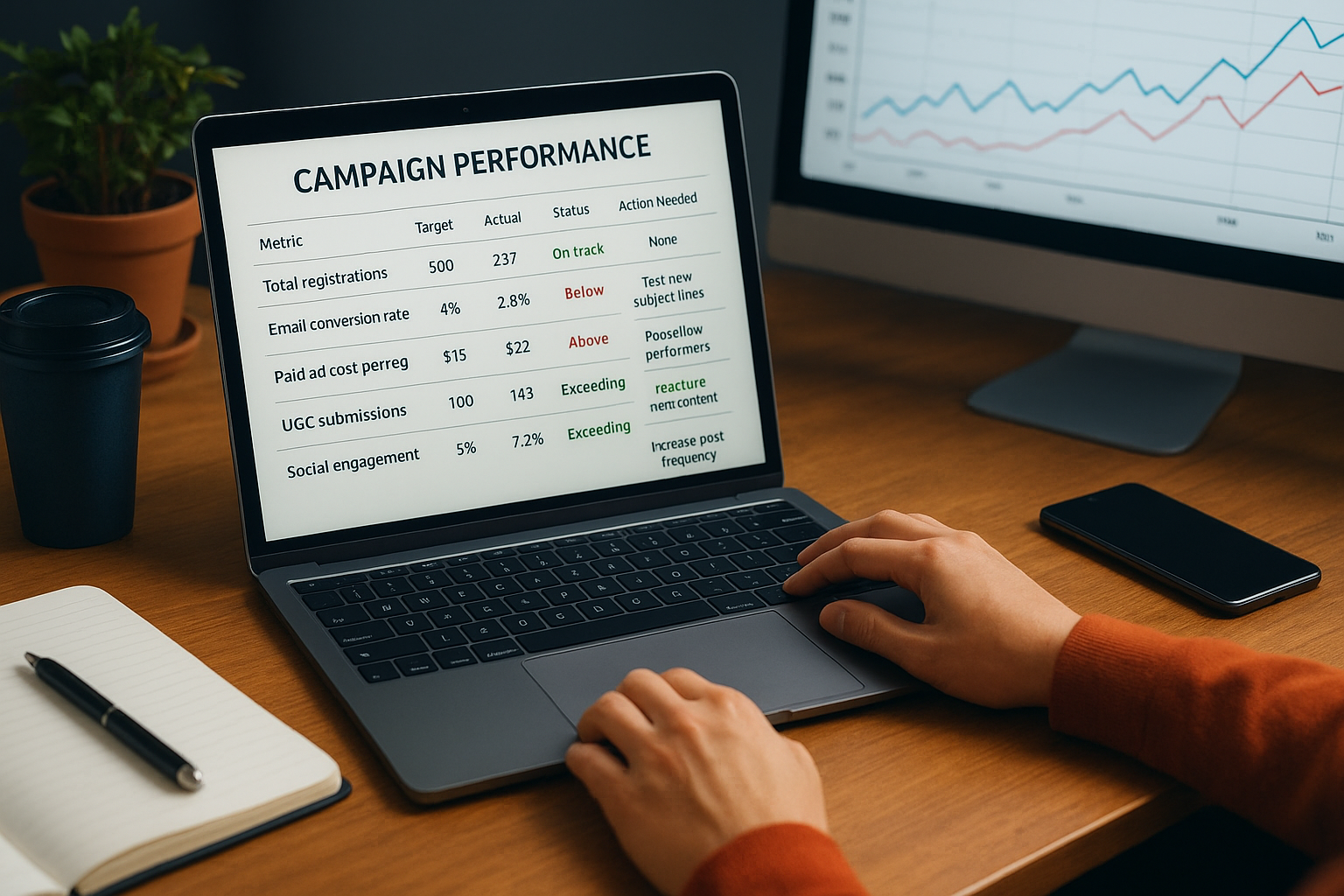
Create a simple tracking sheet that you update every morning during active campaign periods:
| Metric | Target | Actual | Status | Action Needed |
|---|---|---|---|---|
| Total registrations | 500 | 287 | On track | None |
| Email conversion rate | 4% | 2.8% | Below | Test new subject lines |
| Paid ad cost per reg | $15 | $22 | Above | Pause low performers |
| UGC submissions | 100 | 143 | Exceeding | Feature more content |
| Social engagement | 5% | 7.2% | Exceeding | Increase post frequency |
Respond to audience signals immediately
You adjust your tactics based on performance patterns that emerge during your campaign. When one message angle drives significantly more registrations than others, you create more variations of that message. When a specific audience segment shows higher conversion rates, you shift budget toward reaching more people like them. When attendee-generated content produces higher engagement than your professional materials, you feature more UGC in your promotional mix.
Small tactical shifts during your campaign produce dramatically better results than waiting to apply learnings to your next event.
Build flexibility into your campaign by pre-approving budget reallocation authority and creating backup content you can deploy quickly. Keep a reserve of social posts, email variations, and ad creative ready to launch when opportunities appear or original tactics underperform. Empower your team members to make channel-specific adjustments without requiring executive approval for every change. Speed matters more than perfection when you're responding to real-time audience behavior.
Set decision triggers that prompt immediate action when thresholds hit. If registrations fall 20% behind projections three weeks before the event, you activate your discount code campaign early. If paid ads exceed performance targets, you increase daily spend limits. If a partner promotion drives unexpected registration spikes, you coordinate additional joint content. Your triggers remove hesitation and create automatic responses to common scenarios.
Step 7. Measure results and optimize next time
Your event ends but your marketing strategy doesn't. The post-event measurement phase determines whether you achieved your goals, identifies what worked and what failed, and creates documented learnings that improve your next campaign. You need to collect final performance data, calculate return on investment across channels, survey attendees about their experience, and compile everything into a post-mortem report that guides future decisions. This step transforms one-time tactical knowledge into repeatable strategic advantage.
Most event organizers skip rigorous post-event analysis because they immediately move to planning the next program. This costs you the insights that separate good campaigns from exceptional ones. When you understand what is event marketing strategy at its completion, you recognize that measuring results systematically creates compounding improvements across multiple events instead of starting from zero each time.
Calculate ROI across all channels
You determine which promotional channels justified their investment by calculating cost per registration and total ROI for each one separately. Add up all expenses for email marketing, paid advertising, content creation, influencer partnerships, and other tactics. Divide the total cost by registrations attributed to each channel to find your cost per acquisition. Compare these numbers against your initial projections and industry benchmarks to identify your most efficient channels.
Track both direct and assisted conversions because some channels initiate interest while others close the sale. Someone might discover your event through social media but register after receiving an email reminder. Attribution models help you understand the full customer journey instead of crediting only the final touchpoint. Use this data to inform channel budget allocation for your next event.
Channels that delivered registrations at the lowest cost deserve increased investment next time, even if they weren't your original priority.
Document your results using this analysis template:
| Channel | Total Spend | Registrations | Cost Per Reg | ROI | Next Event Action |
|---|---|---|---|---|---|
| Email marketing | $500 | 147 | $3.40 | 740% | Increase budget 25% |
| Facebook ads | $2,000 | 98 | $20.41 | 196% | Maintain budget |
| Influencer partnerships | $1,500 | 76 | $19.74 | 203% | Test different influencers |
| LinkedIn ads | $1,200 | 31 | $38.71 | 103% | Reduce or eliminate |
| Organic social | $0 | 89 | $0 | Infinite | Feature more UGC |
Document learnings for future events
You create a comprehensive post-mortem document that captures what worked, what failed, and specific recommendations for improvement. Include quantitative data (registration rates, conversion metrics, engagement statistics) alongside qualitative feedback from attendee surveys, team debriefs, and partner conversations. Write this document while details remain fresh, typically within two weeks after your event concludes.
Your post-mortem should answer these critical questions with specific evidence and examples: Which promotional messages generated the most engagement? What objections prevented prospects from registering? Which content formats produced the highest conversion rates? When did registration patterns peak and why? What unexpected audience segments showed strong interest? Which partnerships delivered the best results? What technical issues disrupted your promotional flow?
Structure your learnings document with these essential sections that make insights actionable:
EVENT MARKETING POST-MORTEM

Event: [Name and Date]
Total Registrations: [Number vs. Goal]
Total Revenue: [Amount vs. Goal]

TOP PERFORMERS:
- [Channel/tactic]: [Specific results and why it worked]
- [Channel/tactic]: [Specific results and why it worked]
- [Channel/tactic]: [Specific results and why it worked]

UNDERPERFORMERS:
- [Channel/tactic]: [Results and why it failed]
- [Channel/tactic]: [Results and why it failed]

KEY INSIGHTS:
1. [Specific learning about audience behavior]
2. [Specific learning about message effectiveness]
3. [Specific learning about timing or channels]

RECOMMENDATIONS FOR NEXT EVENT:
- [Specific action based on this campaign's data]
- [Specific action based on this campaign's data]
- [Specific action based on this campaign's data]

BUDGET REALLOCATION:
- Increase: [Which channels and by how much]
- Decrease: [Which channels and by how much]
- Test: [New channels or tactics to try]
Bring your strategy to life
You now understand what is event marketing strategy and have a complete framework to build one that fills seats and generates authentic content. The seven steps you've learned transform scattered promotional efforts into coordinated campaigns that reach the right people, create compelling reasons to attend, and turn attendees into advocates who amplify your message organically.
Your strategy works best when you combine planned promotional content with attendee-generated videos and photos that showcase real experiences. Every video your attendees capture becomes promotional content for your next event, creating a virtuous cycle that reduces production costs while increasing authenticity. This multiplier effect makes user-generated content the most powerful component of modern event marketing.
SureShot makes collecting this content effortless. Your attendees upload their favorite moments through a simple mobile app using unique event codes, and our AI helps you identify the best clips for promotion. Book a demo to see how event organizers are turning every attendee into a content creator who drives organic reach and builds lasting community engagement.